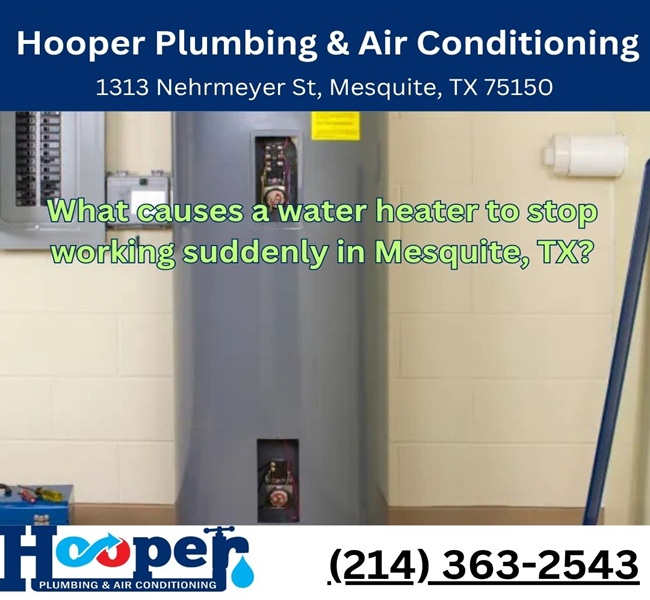
A water heater stops working suddenly in Mesquite most often because of a tripped thermal cutoff, a failed pilot light, an activated temperature and pressure relief valve, sediment overload, or a tankless unit triggering an automatic error shutdown. While the failure feels like it came out of nowhere, Mesquite’s hard water supply and extreme summer heat quietly stress water heaters long before any visible sign appears. For homeowners, landlords, and property managers in this area, understanding what actually triggers abrupt shutdowns is the first step toward knowing whether you need a plumber for an emergency repair, a scheduled diagnostic, or a full unit replacement.

Sudden Failure Is Not the Same as Gradual Decline
Why Abrupt Shutdowns Catch Mesquite Homeowners, Landlords, and Property Managers Off Guard
Most people expect a water heater to slow down before it stops. The water gets a little less hot, recovery time stretches out, the unit starts making noise. That pattern describes gradual decline, and it gives you time to plan. Sudden failure is different. The unit was working yesterday morning. Today it is not working at all. That shift happens in hours, not months, and it almost always traces back to a specific component failure or a safety mechanism doing exactly what it was designed to do. For landlords and property managers overseeing multiple Mesquite units, a sudden shutdown is particularly disruptive because tenants cannot self-diagnose the cause. The call comes in as “no hot water,” with no additional context. Knowing what typically forces an abrupt shutdown helps you ask the right questions and prioritize the correct service response.The Local Conditions That Compress the Timeline to Failure
Mesquite receives water with a high mineral content, particularly calcium and magnesium. That hard water leaves scale deposits inside every water heater it passes through. Scale acts as insulation between the heating source and the water, forcing internal components to work at temperatures higher than they were built to sustain. Over time, that thermal stress degrades components that would otherwise last years longer in a softer water environment. The result is that a water heater in Mesquite can reach a sudden failure point significantly earlier than the manufacturer’s rated lifespan suggests. Combine hard water with summer temperatures that regularly push past 100 degrees Fahrenheit, and you have an environment where thermal pressure inside a tank climbs fast and internal safety mechanisms activate more frequently. This is not a design flaw in your unit. It is the predictable outcome of operating standard equipment in a demanding local climate.The Most Common Causes of a Sudden Water Heater Shutdown in Mesquite
Tripped Thermal Cutoff or Circuit Breaker (Electric Tank Units)
Electric water heaters draw a significant amount of current, and they are typically connected to a dedicated double-pole circuit breaker. When something causes the unit to draw more power than normal, or when a component shorts internally, the breaker trips and the unit loses power entirely. From the homeowner’s perspective, the water heater simply stopped. From a diagnostic perspective, the tripped breaker is a symptom, not the root cause.What Forces the Thermal Cutoff to Trip Without Warning
Electric tank units also contain a high-limit thermal cutoff, sometimes called an ECO (energy cutoff), located behind the upper thermostat access panel. This device monitors water temperature inside the tank. If the temperature exceeds a safe threshold because of a stuck thermostat, a failing heating element, or sediment buildup forcing extended heating cycles, the thermal cutoff trips and shuts off power to both heating elements. The unit will not produce hot water again until the cutoff is manually reset. In Mesquite’s hard water environment, sediment accumulation forces heating cycles to run longer and hotter than normal, which is a direct and common trigger for thermal cutoff trips. Professional Water Heater Repair is the appropriate response when the cutoff will not hold a reset after the root cause has been addressed.Pilot Light Failure or Gas Supply Interruption (Gas Tank Units)
Gas water heaters rely on a continuously burning pilot light to ignite the main burner. If the pilot goes out, the burner cannot fire, and hot water production stops immediately. The thermocouple, a small safety sensor positioned in the pilot flame, detects whether the pilot is lit. If it does not sense heat, it closes the gas valve automatically to prevent unburned gas from accumulating. A thermocouple that has worn out or been coated in residue will trigger this shutoff even when the pilot attempts to stay lit.How Summer Demand Spikes and Pressure Drops Create Sudden Gas Water Heater Failures
During Mesquite’s peak summer months, increased gas demand across the service area can produce brief drops in line pressure. A gas water heater needs adequate pressure to hold the pilot flame stable and to fire the main burner at the correct rate. A pressure dip at the wrong moment can extinguish the pilot without any mechanical failure on the unit itself. When this happens repeatedly, homeowners may notice the pilot going out more frequently in summer than at other times of year. If a gas line fitting has also developed even a minor restriction from corrosion, the problem compounds quickly.TPR Valve Activation: A Built-In Shutoff Most People Misread as a Leak
The temperature and pressure relief valve, commonly called the TPR valve, is a critical safety component on every tank water heater. Its job is to release water if the temperature or pressure inside the tank climbs beyond safe operating limits. When it activates, water drains from a discharge pipe near the base of the unit. Most homeowners see the puddle and assume the tank is leaking. The distinction matters because a leaking tank typically requires replacement, while a TPR valve that discharged and re-seated may indicate a thermostat set too high, mineral scale forcing temperatures upward, or a valve that has weakened after years of mineral exposure and needs replacement on its own. In Mesquite, scale deposits that insulate the tank bottom force the burner or element to run longer and hotter. This thermal accumulation can push tank temperature high enough to trigger TPR activation even when the thermostat setting appears normal.Sediment Overload Triggering an Automatic Shutdown
As hard water minerals settle to the bottom of a tank over months and years, the sediment layer grows thicker. In a gas unit, the burner flame heats the tank floor directly, and a thick sediment layer traps superheated pockets of water beneath it. Those pockets create the popping and rumbling sounds that signal serious buildup. In extreme cases, that steam and pressure activity forces the thermostat or TPR valve to respond. In an electric unit, the lower heating element becomes encrusted with scale to the point where it can no longer transfer heat efficiently, causing it to overheat and fail outright. When the element burns out, the unit stops producing hot water with no prior warning sound.How Tankless Water Heaters Shut Down Differently Than Tank Units
Tankless water heaters do not store water, so sediment accumulation at the bottom of a tank is not their primary failure mode. Instead, they heat water on demand by passing it through a heat exchanger. When scale deposits coat the interior of that heat exchanger, water flow is restricted and the unit cannot maintain safe operating temperatures. Most modern tankless units are equipped with sensors that detect abnormal flow rates, outlet temperatures, or combustion conditions. When a sensor reads outside the acceptable range, the unit shuts itself off and displays an error code. In those situations, Tankless Water Heater Repair and Installation from a technician familiar with Mesquite’s hard water conditions is the most reliable path to restoring service.Error Codes, Flow Sensors, and Heat Exchanger Scaling in Mesquite’s Hard Water Environment
Mesquite homeowners with tankless units should treat any unexpected shutdown with an error code as a mineral scale warning until a professional confirms otherwise. Common error codes on most major tankless brands point to ignition failure, abnormal exhaust temperature, or low water flow through the heat exchanger. Scale restricts that flow. Without periodic descaling maintenance, a tankless unit in a hard water environment like Mesquite can reach the point of automatic shutdown in a fraction of the time it would take in a region with softer water. Tankless units are not self-cleaning. They require proactive maintenance to avoid abrupt failures.How Mesquite’s Environment Accelerates the Path to Sudden Failure
Hard Water Mineral Scale and Thermal Stress on Internal Components
Every gallon of water that moves through a Mesquite water heater leaves behind a microscopic deposit of dissolved minerals. Individually, those deposits are invisible. Collectively, over a year or two of uninterrupted use, they form a layer of insulating scale that forces every heated component in the unit to compensate. Thermostats work at higher temperatures to overcome the insulating effect. Heating elements run longer to meet demand. Burners cycle more frequently. The cumulative thermal stress on seals, valves, and electronic controls shortens component life in ways that are difficult to predict from the outside but entirely consistent with what plumbers see when they open these units up.Extreme Summer Heat, Tank Pressure Buildup, and the Risk of Sudden Shutoff
In July and August, Mesquite’s outdoor temperatures mean that water arriving at the unit from supply lines is already warm. A water heater thermostat set to a standard temperature will cycle on and off more rapidly because the incoming water does not require as much heating to reach the set point. While this sounds like a benefit, the rapid cycling combined with high ambient temperatures around the unit can create elevated pressure conditions inside the tank faster than the expansion tank or pressure relief systems can compensate. Units installed in unconditioned garages or utility closets with poor ventilation are particularly vulnerable because the surrounding air temperature adds thermal load on top of the mechanical load.What to Check in the First 10 Minutes After Your Water Heater Stops
| Unit Type and Symptom | First Check to Perform |
|---|---|
| Electric tank / No hot water at all | Go to the circuit breaker panel and look for a tripped breaker on the water heater circuit. Reset it once and observe whether it holds or trips again immediately. |
| Gas tank / No hot water and no burner sound | Locate the pilot assembly access point at the base of the unit. Check whether the pilot flame is lit. If not, attempt a relight using the instructions printed on the unit label before calling for service. |
| Gas or electric tank / Water pooling near the base | Do not attempt to relight or reset anything. Locate the cold water shutoff valve above the unit and close it. Then contact a licensed plumber to distinguish between a TPR valve discharge and an active tank leak. |
| Tankless unit / Powers on but shuts off during use | Check the digital display panel for an error or fault code. Write down the exact code before calling for service. That code tells a technician which sensor or component triggered the shutdown. |
| Any unit type / Hot water is discolored or rust-tinted | Run the cold water tap at a separate fixture. If the cold water is clear, the discoloration is isolated to the hot water side and points to internal tank corrosion or a depleted anode rod requiring professional evaluation. |
Repair or Replace? What Mesquite Homeowners, Landlords, and Property Managers Need to Weigh
Not every sudden shutdown means the unit is at the end of its life. A tripped breaker, a blown pilot thermocouple, or a TPR valve that needs replacement are repairs that can extend a unit’s useful service life if the tank itself is structurally sound and the unit is not yet past its expected lifespan. The calculation changes when the unit is over ten years old and operating in Mesquite’s hard water environment. At that age, sediment accumulation, anode rod depletion, and internal corrosion have typically progressed to the point where a repair addresses one symptom while others continue developing. For property managers overseeing multiple units or rental properties, a proactive replacement on an aging water heater often costs less than managing repeated service calls, emergency visits, and the water damage risk that comes with a failing tank. Exploring New Water Heaters at that stage is often the more sound long-term investment. A licensed plumber can assess whether the tank interior shows signs of significant corrosion, whether the sediment layer has reached a point of no return, and whether the unit’s remaining components are worth the investment of a repair. That assessment should always inform the decision rather than guessing based on age alone.When a Sudden Water Heater Shutdown in Mesquite Requires Emergency Service
Some sudden shutdowns are inconvenient. Others are urgent. Contact a plumber immediately if you observe any of the following conditions:- Water is actively releasing from the TPR valve discharge pipe and does not stop after the thermostat is adjusted downward
- You smell natural gas near a gas water heater at any point during or after troubleshooting
- The circuit breaker trips again immediately after being reset, indicating a short in the unit
- Visible corrosion or rust is present on the exterior tank surface, particularly near the bottom seam
- Standing water has accumulated around the base of a tank unit in an amount that exceeds minor condensation